
When the record is incomplete, you’ve already lost the dispute
Incident to violation workflow gaps are why most disputes escalate—not because residents are unreasonable. They escalate because the record is incomplete. A verbal warning given in a hallway. A follow-up buried in a group text thread. A timeline no one can reconstruct two months later when the third incident happens and someone finally threatens legal action. By the time something escalates in your building, facts blur. Memory fills the gaps. And what started as a straightforward noise complaint becomes an argument no one can cleanly resolve not because the violation didn’t happen, but because you can’t prove it did.
Why enforcement breaks down
(It’s not a people problem)
The real question is never whether your staff tried. It’s whether your enforcement system produces a complete record by default or depends on individuals remembering to log things at the right time. If the answer is the latter, you don’t have an enforcement system. You have a set of habits. And habits fail under pressure during staff turnover, peak leasing season, or the exact moment a resident decides to push back hard.
A noise complaint comes in at 11 PM. The manager on duty gives a call for a verbal warning to the unit. The resident denies it ever happened. Six weeks later, the same resident is on their third incident without a track record of previous warnings. That’s not a staffing failure. That’s a process failure.
The buildings that avoid this outcome are more mechanical about how violations get recorded. Every incident is logged at the time it happens. Every violation is timestamped and tied to the unit. Every conversation is attached to the same thread. Every escalation stage is predefined before the dispute starts. When enforcement follows that structure, the process makes the decision and the staff just follows the steps. Some communities do a great job in keeping record of incidents, and even have video footage attached. But many still rely on email communication, and incident records are kept in an individual’s inbox rather than a central document repository that is easily retrievable.
Use case: Real numbers from Community X since launch
Since Unify LIV launched at Community X in September 2025, the AI Analytics dashboard has been capturing connected enforcement data across two towers not just how many events were reported, but how quickly reviewed, whether evidence was attached, and where cases stand at any point in time.
INCIDENT REPORTS COMMUNITY X | SEPT 2025 – APR 2026
VIOLATIONS COMMUNITY X | SEPT 2025 – APR 2026
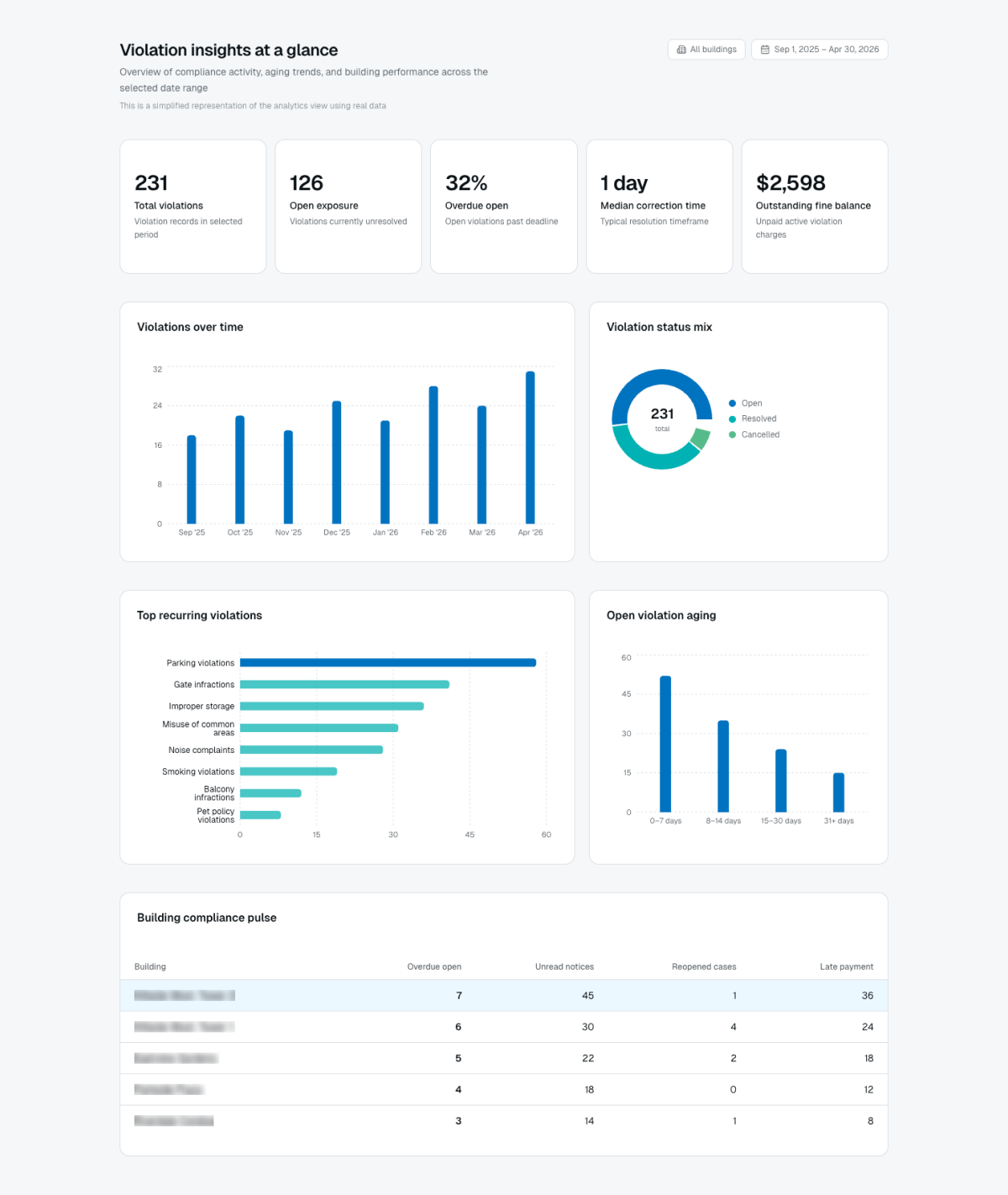
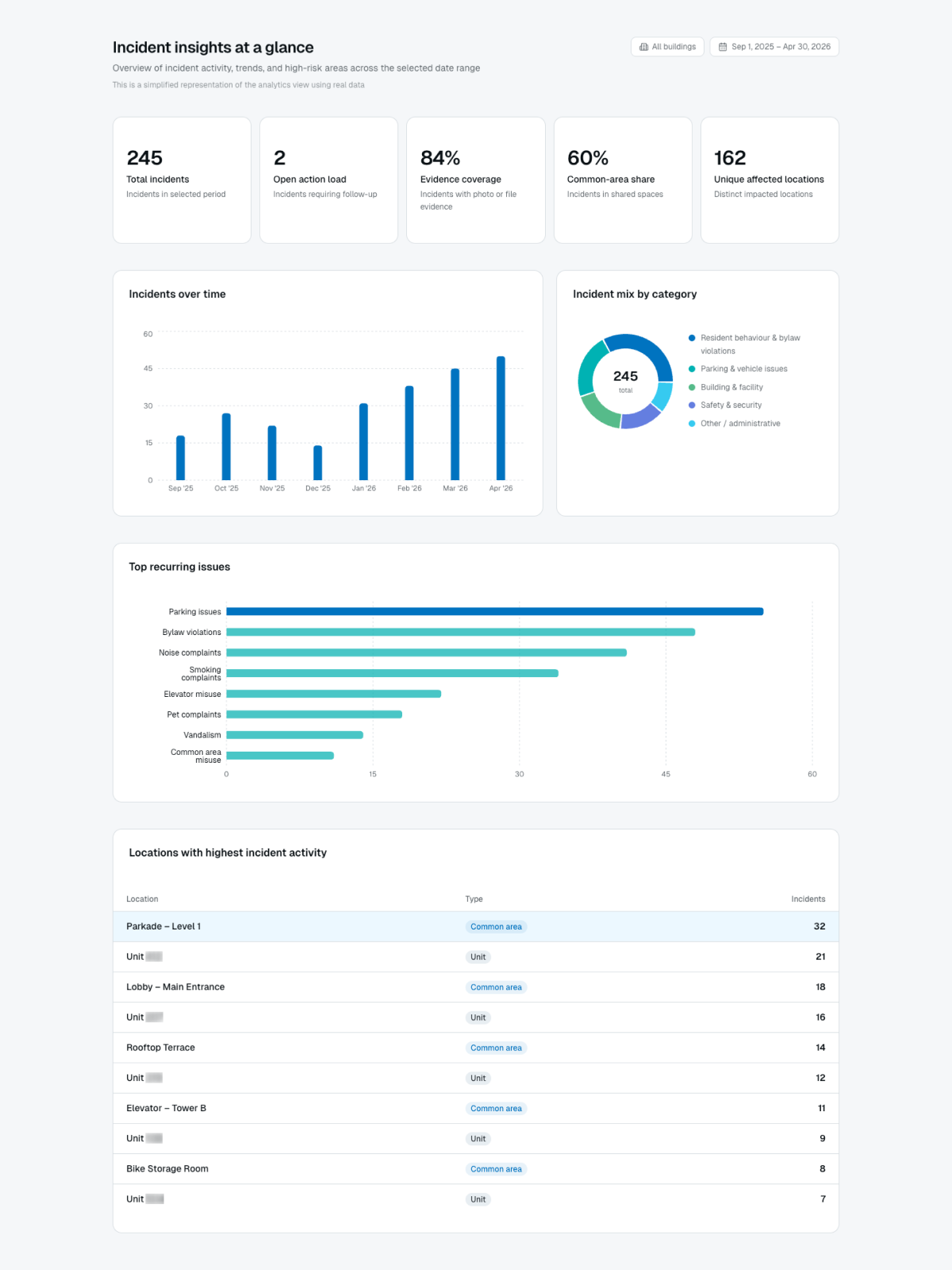
Nearly all incidents 96% were reviewed by staff, with only three pending follow-up. Evidence coverage exceeded 92%, meaning the vast majority of reports were filed with photos, video links, or documentation attached. Without evidence, you have a story. With evidence, you have a record. The 118 violations currently open aren’t a sign of inaction. This property management team’s operational workflow is deliberate: violations are reviewed and formally closed at the end of each month during a council meeting. What Unify LIV provides in that workflow is complete visibility and zero amnesia. The team knows exactly how many violations are pending. Every ticket whether issued last week or six weeks ago is fully documented with its evidence, communication thread, and escalation history intact. The oldest open violation, a noise complaint at 155 days, has its full record preserved: original report, evidence, every message exchanged, and the current escalation stage. When it reaches the council table, nothing is missing. Nothing falls through the crack. When violation fines are attached to the final warning, residents can pay directly in the app using LIV Pay. Staff no longer need to chase outstanding fines, and the board can ensure payments are collected on time before amounts accumulate.
AI-Generated insights: What the system surfaces without being asked
Unify LIV’s AI-generated summary sits above both the Incident Reports and Violations dashboards. Rather than forcing managers to parse raw tickets, it automatically surfaces patterns, flags priorities, and identifies trends updated at every page refresh, regenerated on demand with a single click.
- 4 incidents pending review, including 2 open over 15 days
- One building accounts for 75% of incidents in the last 7 days
- Incident volume surged 300% vs. previous week (4 vs 1)
- No repeat units detected in the last 3 days
- 234 incidents reviewed with strong closure rate
- 96% of incidents reviewed, showing strong follow-up
- 118 violations open pending monthly council review
- Oldest open violation (155 days, noise complaint) fully documented
- Two buildings identified as recent activity hotspots
- Violation volume dropped 60% vs previous week (2 vs 5)
- 54.6% of violations held intentionally for monthly batch review
For a team managing 890+ doors, this is the difference between reactive firefighting and proactive management. The dashboard doesn’t flag open violations as failures; it tells the team exactly how many are queued for the next council review, confirms every case is documented, and surfaces any escalated disputes that need attention before the meeting. A 300% spike in incident volume, a concentration of activity in one building, a case open for five months but fully documented all surfaced automatically, all with direct links to the relevant record.
Top 3 incident trends
1. Bylaw violations & Resident behaviour 62% of all incidents
Bylaw violations are the single largest subcategory with 122 reports nearly double the next-highest category. These include noise complaints, smoking in non-designated areas, and disruptive conduct. The challenge is recurrence: without a connected record showing prior warnings and escalation history, every new incident gets treated as a first offence. With it, the escalation path is visible and defensible. The AI noting no repeat units in the last three days also signals that targeted communication may be more effective than enforcement escalation right now, a distinction a manual spreadsheet can’t make.
2. Parking & Vehicle issues 35%+ of all violations
Gate infractions alone represent over 35% of all violations issued since launch. A resident who drives through a closing gate has committed both a safety violation and a policy breach. Without video evidence, a fob transaction log, and a timestamped incident record, it becomes a he-said/she-said situation. The next section shows how Unify LIV handles this case from first report to formal violation in a single workflow.
3. Building & Facility issues 39.42% common-area share across 159 locations
Door and elevator incidents rank third. Individually minor; collectively they consume significant staff time and affect every resident when shared infrastructure is involved. The 159 distinct impacted locations across this one community shows why common-area incidents require a broadcast protocol tied to the maintenance workflow otherwise, residents call. And keep calling.
From Incident to violation in one screen
Incidents and violations in Unify LIV are not siloed workflows. They are connected eliminating the double-entry problem that causes enforcement records to fall apart under pressure.
- 2 CCTV video links capturing the gate infraction in real time
- Fob transaction history screenshot confirming entry time and unit
- 9:45 PM — Report submitted; property manager automatically notified
- 10:32 PM — Evidence updated and report finalized by on-site team
The on-site team filed the report, attached two CCTV links and a fob transaction screenshot, and the assigned property manager was automatically notified all within 47 minutes, timestamped, tied to the unit, stored in one place. From within this same ticket screen, the property manager sees a “Create Violation” button. One click, no switching platforms, no re-entering information, no copying evidence links and a formal violation is issued with all supporting documentation automatically carried over. The concierge report, CCTV footage, and fob transaction log become one record. That is what removes the he-said/she-said dynamic from enforcement entirely. When the resident receives the violation notification and disagrees, they respond through the in-app chat attached to that same ticket. The staff reply, the resident’s dispute, the manager’s decision: all time-stamped, all stored in one thread. All parties resident, on-site staff, property manager, board council members see the same data, providing full transparency and compliance. There is nothing to reconstruct later, because it was never fragmented in the first place.
The four-layer enforcement record that protects your team
A complete violation record needs four layers all in the same place, tied to the same unit and user.
- The warning sequence. First warning, second warning, then final warning with the charge. If you can’t prove the warning sequence happened, you can’t defend the charge. Unify LIV tracks this ladder automatically, each stage timestamped under the unit. The follow-up queue surfaces cases of stalling at any stage.
- The evidence. Photo or video evidence attached at the time of the incident not retrieved later. The 92.53% evidence coverage rate reflects this discipline.
- The communication history. Every message sent to the resident is timestamped and stored in the violation thread. This stops the “I never received a warning” argument. Not a policy. A timestamped record of delivery.
- The payment trail. When a charge is issued, it ties directly to the violation record. When someone disputes a fee, you open one screen and see the charge, the evidence, and the history that justified it. The charge exists as the end of a documented sequence, not in isolation.
When all four layers exist together, the enforcement record does the work that staff used to do under pressure imperfectly, from memory, at the worst possible moment.
Most disputes aren’t about what happened. They’re about what wasn’t recorded. When a resident can see what was logged, when it happened, and what stage the process is in the argument loses its footing. Good enforcement isn’t louder. It’s clearer.
The record isn’t paperwork. It’s protection.